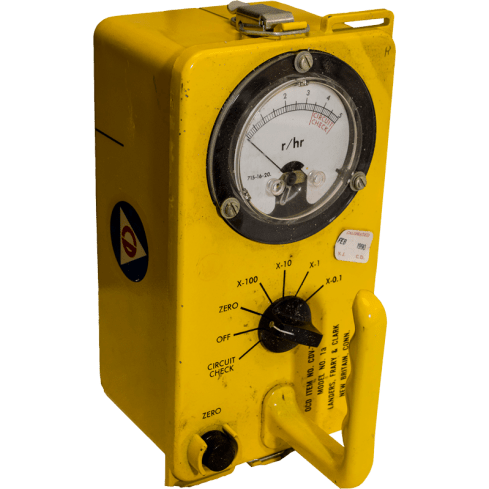
The Geiger-Müller counter (frequently called simply the Geiger counter) is an electronic tool designed to detect the levels of radiation surrounding it. Originally conceptualized by Hans Geiger and developed jointly with Walther Müller.
Above depicts the exact model (CDV-715) of a portable Geiger counter that my father owns. My father’s nickname that others have given him (that he wears with pride) is Worst Case Wallace, as he always dwells on the worst case scenario. Appropriately, he bought this at the tail end of The Cold War, a time where the masses feared heavily the possibility of nuclear war. Although this object was made for people who worked closely with radioactive materials, my father kept this in the back of his car for decades as he too feared the possibility of nuclear fallout.
Ultimately, I feel as if, although a bit extreme from my understanding, my father’s actions conveys the fear that was dwelling on people at the time, and to a lesser extent, now. Its application for public history is noteworthy, as its design, although antiquated by today’s standards, exhibits the rapidly increasing knowledge on radiation and its detection considering the first model was made in 1961, as well as a depiction of the paranoia particularly present at the time, at least when paired up with the background my father shares with it, making it powerfully paint the emotions of the times to someone like me, someone born post-Cold War.
 Site Title
Leave a comment